What If Your AI Makes a Wrong Decision?
Artificial Intelligence Management Systems are becoming one of the most important business management frameworks of the digital era. Imagine an AI system rejecting a qualified loan applicant, exposing sensitive customer data, or making hiring decisions based on hidden bias. These are no longer fictional scenarios; they are real challenges organizations worldwide are facing as artificial intelligence becomes part of everyday business.
Now, ask yourself this: Who is responsible when AI makes a mistake?
Can organizations simply trust AI without governing it? The answer is no.
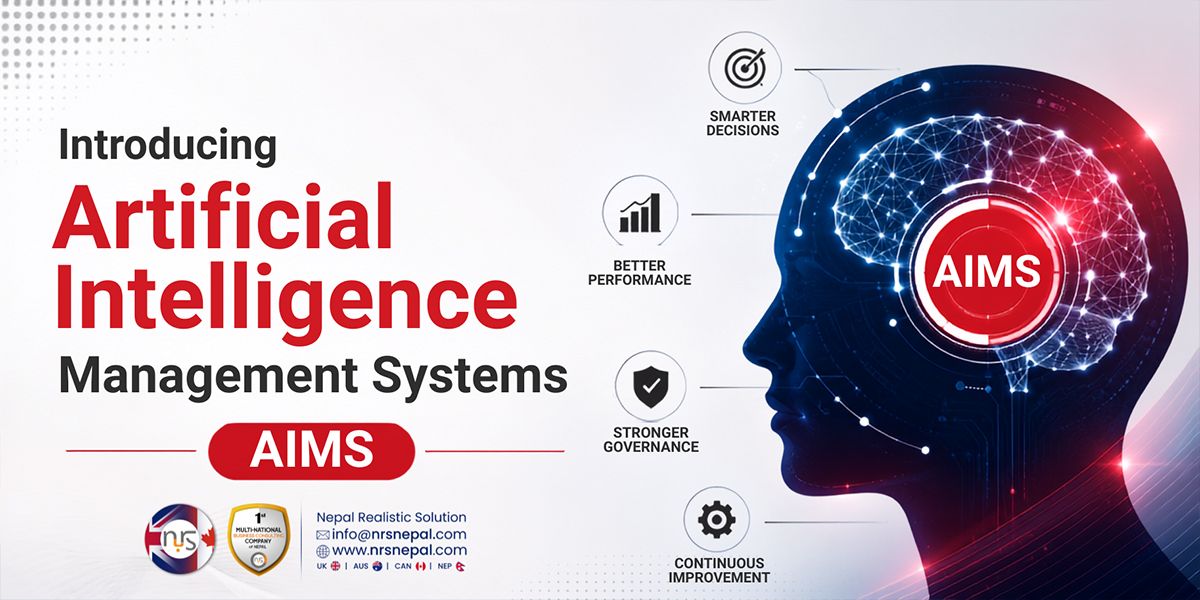
Just as organizations rely on internationally recognized management systems for quality, information security, and environmental management, artificial intelligence also requires a structured framework to ensure it is used responsibly. This is exactly where Artificial Intelligence Management Systems (AIMS) come in.
We are excited to introduce AIMS to Nepal, helping organizations prepare for the next generation of responsible AI governance.
What Is an Artificial Intelligence Management System (AIMS)?
An Artificial Intelligence Management System (AIMS) is a structured framework that enables organizations to develop, deploy, monitor, and continuously improve artificial intelligence responsibly. It helps businesses ensure that AI is not only innovative but also ethical, transparent, secure, and aligned with internationally recognized best practices.
Think of it this way:
Artificial Intelligence is the engine. AIMS is the steering wheel that keeps it moving in the right direction.
Without proper governance, even the most advanced AI system can create significant legal, ethical, financial, and reputational risks.
With an effective management system, organizations gain confidence that AI supports business growth while protecting customers, employees, and stakeholders.
Why Does AI Need a Management System?
Artificial intelligence is rapidly changing industries across the world. From hospitals diagnosing diseases to banks detecting fraud, manufacturers automating production, universities improving learning experiences, and businesses enhancing customer service, AI is transforming the way organizations operate.
However, every opportunity comes with responsibility.
Artificial Intelligence Management Systems help organizations answer critical questions such as:
- Who is accountable for AI decisions?
- How do we reduce bias in AI systems?
- Is customer data being protected?
- Can AI decisions be explained and justified?
- How do we monitor AI performance over time?
- What happens when an AI system fails?
- How can we continuously improve AI safely?
Rather than reacting to problems after they occur, organizations can proactively manage AI risks while encouraging responsible innovation.
Why Artificial Intelligence Management Systems Are Becoming Essential
Around the world, governments, regulators, multinational corporations, and customers are placing greater emphasis on responsible AI. Organizations are no longer judged solely on how advanced their AI is; they are also evaluated on how responsibly it is managed.
Artificial Intelligence Management Systems help organizations:
- Build trust with customers and stakeholders.
- Strengthen AI governance and accountability.
- Improve decision-making through structured processes.
- Reduce operational, legal, and reputational risks.
- Promote transparency and ethical AI practices.
- Support continual improvement throughout the AI lifecycle.
- Enhance confidence among investors, partners, and regulators.
In the digital economy, responsible AI is becoming a competitive advantage rather than an option.
Why This Matters for Nepal
Nepal is experiencing rapid digital transformation. Organizations across banking, healthcare, education, manufacturing, tourism, telecommunications, and information technology are increasingly exploring artificial intelligence to improve efficiency and innovation.
Yet adopting AI is only the first step.
Managing AI responsibly is what creates long-term success.
That is why Artificial Intelligence Management Systems represent an important milestone for Nepal. They provide organizations with an internationally aligned framework to govern AI responsibly, reduce uncertainty, strengthen trust, and prepare for a future where AI becomes an essential part of business operations.
Forward-looking organizations that establish strong AI governance today will be better positioned to compete in both national and international markets tomorrow.
Why NRS Is Leading This Important Conversation
We believe Nepalese organizations deserve access to globally recognized management system solutions that prepare them for the future.
By introducing Artificial Intelligence Management Systems to Nepal, we are helping organizations move beyond simply adopting AI toward managing AI with confidence, accountability, and excellence.
Our objective is not only to support certification but also to create awareness, build capability, and encourage responsible AI adoption across industries. As AI continues to reshape the business landscape, organizations that invest in governance today will be the ones that inspire trust and lead tomorrow.
The Future Belongs to Organizations That Govern AI Responsibly
Artificial intelligence is changing the world faster than ever before. The question is no longer whether organizations should adopt AI.
The real question is:
"Is your organization ready to manage AI responsibly?"
Artificial Intelligence Management Systems provide the roadmap for answering that question with confidence.
As Nepal enters a new era of digital innovation, now is the time for organizations to embrace responsible AI governance, strengthen stakeholder trust, and prepare for sustainable growth.
NRS is proud to support Nepal's journey toward a future where artificial intelligence is not only powerful but also responsible, transparent, and trusted.
The future of AI begins with innovation. The future of successful AI begins with management.